
Residents and local officials in Box Elder County, Utah, are intensifying their opposition to a proposed massive data center project, citing concerns over water usage and the preservation of the rural landscape. The development, which has been linked to investor and television personality Kevin O’Leary, faces significant regulatory and community hurdles as it seeks to secure essential infrastructure in a region already grappling with environmental stress near the Great Salt Lake, according to reports from The Salt Lake Tribune.
The controversy centers on the massive energy and water requirements inherent to modern artificial intelligence infrastructure. As the project undergoes preliminary review, O’Leary has publicly characterized the pushback as a potential symptom of foreign interference, specifically suggesting that Chinese interests may be attempting to stall U.S. technological advancements through local environmental activism. However, local stakeholders maintain that their primary concerns are domestic and rooted in the long-term sustainability of their community, as documented by Roll Call.
Infrastructure Demands and Environmental Constraints
Data centers, which house the servers necessary to power cloud computing and AI, require vast amounts of electricity and water for cooling systems. In Box Elder County, the proposal has prompted a “rural rebellion” among residents who fear the transformation of the region’s traditional agricultural and scenic character. According to analysis from New Lines Magazine, the project highlights a growing national tension between the rapid expansion of the digital economy and the finite natural resources of the American West.

The Great Salt Lake, already at historically low levels, serves as a focal point for the debate. Critics argue that the industrial footprint of a major data center could exacerbate regional water shortages. While developers often point to advanced liquid cooling technologies to mitigate usage, local water boards and environmental groups remain skeptical, noting that the scale of these facilities often outpaces the capacity of rural infrastructure, as reported by The New York Times.
The Foreign Interference Claim
Kevin O’Leary, known for his role on the investment program “Shark Tank,” has publicly linked the opposition to his data center project to geopolitical competition. In various statements, he has alleged that Chinese actors, or those influenced by them, are using environmental organizations to delay critical American infrastructure projects. This framing has shifted the discourse from a local zoning dispute to a matter of national security and economic competitiveness.
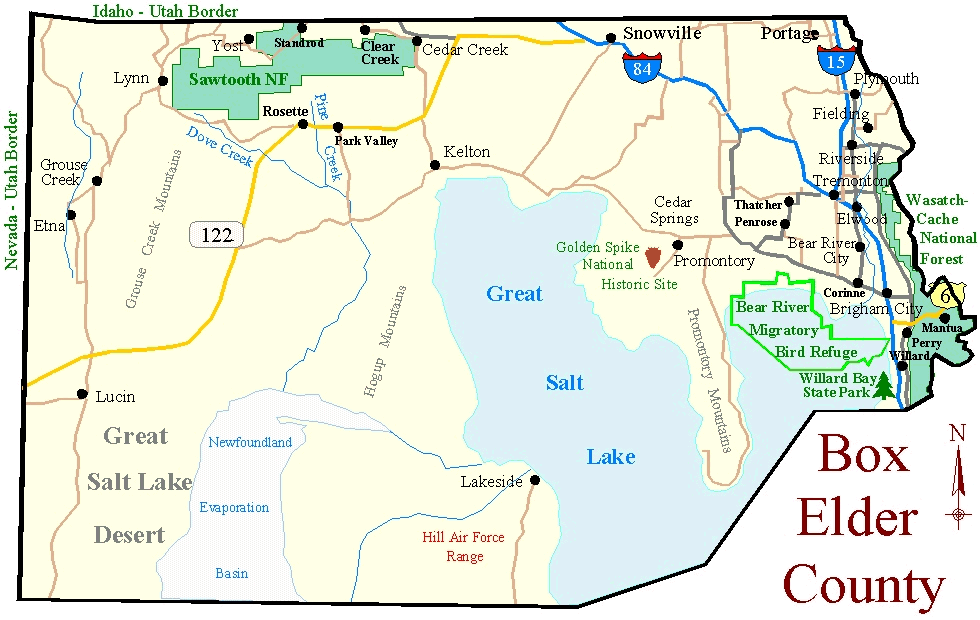
Despite these allegations, there has been no official government evidence presented to confirm that the opposition in Box Elder County is coordinated by foreign entities. The residents involved in the protests have consistently cited local impacts—such as noise pollution, land use, and utility grid stability—as their primary drivers. The disconnect between the developer’s narrative and the residents’ stated grievances has further polarized the public hearings surrounding the project’s permitting process, as noted by Roll Call.
Regulatory Oversight and Legislative Interest
The project has drawn the attention of federal lawmakers, who are increasingly examining the environmental and national security implications of data center development across the United States. Because these projects often seek federal support or benefit from regional power grid integration, they fall under the scrutiny of multiple regulatory bodies. The U.S. Congress is currently monitoring how such developments interact with existing environmental protection statutes and energy policy, according to information provided by Roll Call.
Local government agencies in Utah are tasked with balancing the potential tax revenue and job creation promised by the data center against the concerns of their constituents. The permitting process involves complex applications for land rezoning, water rights, and power utility agreements. As of the latest updates, the project remains in the planning phase, with no final approval granted for construction. Observers anticipate that upcoming public meetings will serve as a crucial venue for the developer to address the transparency concerns raised by local advocacy groups.
What Happens Next for the Box Elder Project
The next major milestone for the project involves a series of public hearings and environmental impact assessments required by county and state law. These proceedings are expected to address the specific utility load requirements and the projected impact on local aquifers. Residents and interested parties can track the status of these applications through the Box Elder County official website, which maintains records of land-use applications and upcoming planning commission agendas.

While the developer continues to advocate for the project as a essential component of the nation’s AI future, the local opposition remains organized and vocal. The outcome of this dispute could set a precedent for how rural communities across the U.S. handle the influx of large-scale technology infrastructure. As the debate continues, both the developers and the residents are preparing for a protracted administrative process. Readers are encouraged to monitor local planning commission minutes for updates on project timelines and future public comment opportunities.