
Scientists have successfully created a “mini universe” using cooled atoms to measure the flow of time without relying on traditional clocks, marking a potential leap forward in quantum physics and metrology. The experiment, conducted by researchers at the University of Birmingham, demonstrates that time can be quantified through the isolated behavior of ultracold atoms—an approach that could redefine how precision timekeeping is achieved, according to a study published in Nature.
Traditionally, time is measured using atomic clocks, which rely on the consistent oscillations of atoms like cesium or rubidium. These devices are the gold standard for accuracy, but they depend on external synchronization. The new method, however, isolates a system of cooled atoms in a way that allows time to be inferred from their internal dynamics alone—effectively creating a self-contained “mini universe” where time emerges from the atoms’ interactions.
This breakthrough could have profound implications for fields ranging from quantum computing to satellite navigation, where even minuscule errors in timekeeping can lead to significant discrepancies. The research also challenges the philosophical question of whether time is an external force imposed on systems or an intrinsic property that can be observed within them.
How the Experiment Works: Cooling Atoms to Isolate Time
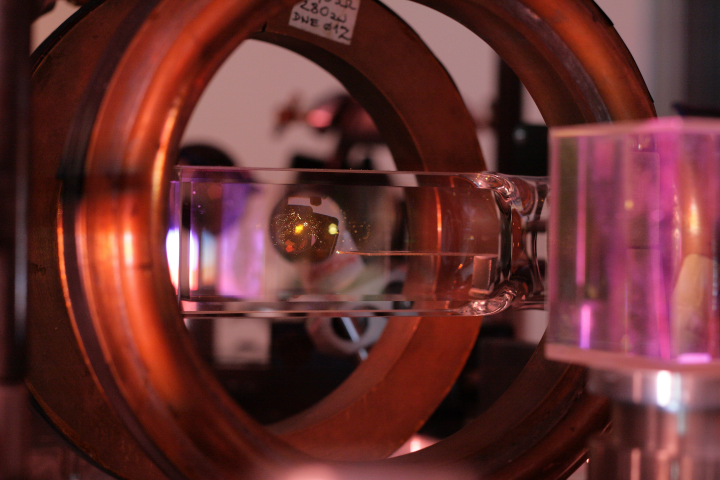
The team at the University of Birmingham used lasers to cool a cloud of rubidium atoms to near absolute zero, creating what is known as a Bose-Einstein condensate (BEC). In this state, the atoms behave as a single quantum entity, allowing researchers to observe their collective dynamics without external interference.

“By trapping these atoms in a controlled environment, we can measure how they evolve over time based solely on their internal quantum states,” explained Dr. Luke Peel, a physicist involved in the study. “This is akin to creating a tiny universe where time is not dictated by an outside clock but emerges from the system itself.”
The experiment builds on decades of research in quantum metrology, where scientists seek to push the limits of measurement precision. While atomic clocks remain the most accurate timekeepers on Earth, this new method opens the door to exploring time as a relational phenomenon—one that is not dependent on an external reference.
Why This Matters: Redefining Timekeeping and Quantum Physics
The implications of this research extend beyond the laboratory. In global positioning systems (GPS), for example, atomic clocks must be synchronized to within nanoseconds to ensure accuracy. A miscalculation of even a few billionths of a second can result in navigation errors of kilometers. If this new method can be scaled up, it could lead to more robust and independent timekeeping systems.

Additionally, the experiment aligns with theoretical work in quantum gravity and the study of spacetime, where time is often treated as a dynamic property rather than a fixed backdrop. “This could help us understand whether time is fundamental or emergent,” said Professor Mark Peil, a co-author of the study. “If time can be measured without a clock, it suggests that it might not be an absolute quantity but something that arises from the interactions within a system.”
For now, the method remains experimental, with the cooled atoms requiring extreme conditions to maintain their quantum coherence. However, the researchers are optimistic about refining the technique to make it practical for real-world applications.
Comparing the Old and New Approaches to Time Measurement
Traditional atomic clocks, like those used by NIST and NPL, operate by counting the vibrations of atoms as they transition between energy states. These clocks are accurate to within a few seconds over billions of years. In contrast, the new method measures time by observing how the quantum state of the BEC evolves without external reference.
Key Differences:
- Dependence on External Reference: Atomic clocks require synchronization with other clocks or signals (e.g., radio signals from satellites). The new method is self-contained.
- Precision: Current atomic clocks are more precise in absolute terms, but the new approach could offer advantages in isolated or noisy environments.
- Philosophical Implications: Atomic clocks treat time as an external parameter, while the BEC method suggests time may emerge from the system itself.
While the new technique is not yet as precise as the best atomic clocks, it represents a fundamental shift in how scientists think about time measurement. “This is not about replacing atomic clocks,” Peel noted. “It’s about exploring a different way to think about time—one that could lead to entirely new technologies.”
What Happens Next: Scaling the Experiment and Potential Applications
The researchers are now working to extend the duration of their observations, as the current setup only maintains coherence for a limited time. If they can increase the stability of the BEC, the method could be applied to quantum sensors or even tests of quantum gravity.
In the nearer term, the breakthrough could influence how time is measured in space-based navigation systems, where traditional clocks face challenges due to relativistic effects. “If we can develop a clock that doesn’t rely on external signals, it could be a game-changer for deep-space missions,” said Peel.
The next phase of the research will involve collaborating with engineers to adapt the technique for practical use. Meanwhile, physicists worldwide are watching closely, as the experiment could open new avenues in both fundamental physics and applied technology.
Key Takeaways: What This Means for Science and Technology
- Time as an Emergent Property: The experiment suggests time may not be an absolute external force but something that arises from the interactions within a quantum system.
- Potential for New Technologies: If scaled, this method could lead to more robust timekeeping in environments where traditional clocks fail, such as deep space or high-noise settings.
- Philosophical Shift: The research challenges long-held assumptions about time, aligning with theories in quantum gravity and the nature of spacetime.
- Collaboration with Industry: Engineers and physicists are now exploring how to adapt the technique for real-world applications, including navigation and quantum computing.
The study was published in Nature and has already sparked discussions in the scientific community. As the research progresses, it could redefine not just how we measure time, but how we understand it.
Next Steps: Researchers plan to present their findings at the upcoming American Physical Society March Meeting in March 2024, where they will discuss potential applications and further experiments.
Have questions about this breakthrough or its implications? Share your thoughts in the comments below or reach out to the World Today Journal team for more insights.