Unveiling the Universe’s Hidden Mass: How Gravitational Waves Will Map Dark Matter
For decades, dark matter has remained one of the most compelling mysteries in modern physics. Constituting roughly 85% of the matter in the universe, its presence is inferred through gravitational effects, yet it remains invisible to direct observation. Now,a groundbreaking study from the University of Amsterdam offers a promising new avenue for unraveling its secrets: leveraging the subtle distortions in gravitational waves emitted by black holes. This research,published in Physical Review Letters,details a complex theoretical model poised to transform our understanding of dark matter’s distribution and basic properties.
The Power of Gravitational Waves: A New Cosmic Probe
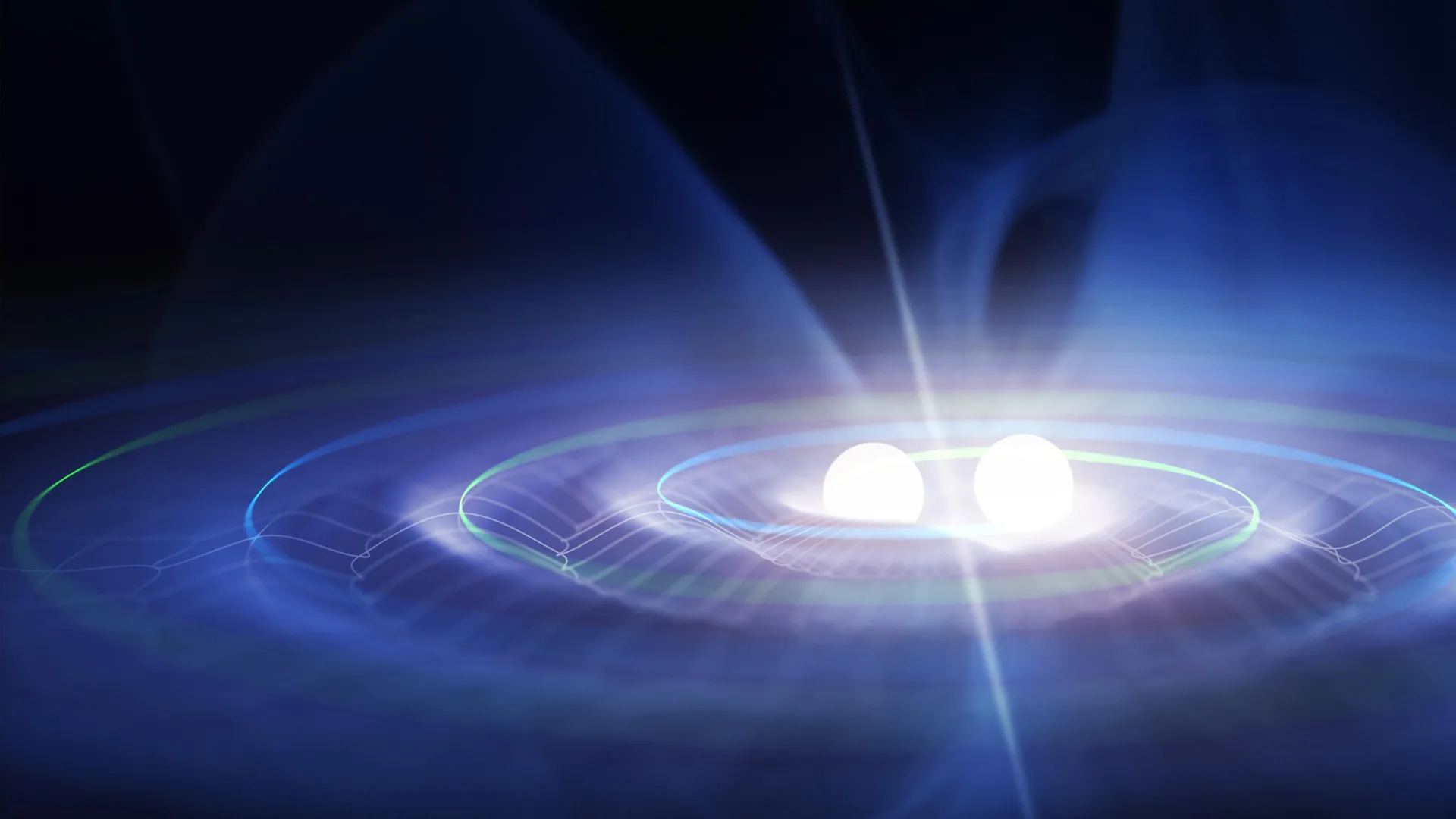
The foundation of this research lies in Einstein’s theory of general relativity and its prediction of gravitational waves – ripples in spacetime caused by accelerating massive objects. Specifically, scientists are focusing on a phenomenon known as extreme mass-ratio inspirals (EMRIs). These occur when a smaller black hole, or other dense object, spirals into a supermassive black hole, typically residing at the heart of a galaxy.
As the smaller object orbits and descends, it emits gravitational waves that, if observed with sufficient precision, act as incredibly detailed probes of the surrounding environment. Upcoming space missions, most notably the European Space Agency’s Laser Interferometer Space Antenna (LISA), slated for launch in 2035, are designed to detect these faint signals over extended periods – potentially months or even years, tracking hundreds of thousands or millions of orbits. This prolonged observation time is crucial, allowing scientists to build a comprehensive picture of the spacetime around these massive objects.
Beyond Newtonian Approximations: A fully Relativistic Model
Previous attempts to model these systems frequently enough relied on simplified Newtonian approximations. While useful as a starting point, these methods inevitably omit crucial physical effects, hindering the accuracy of dark matter detection. The team at the UvA Institute of Physics (IoP) and the GRAPPA center of excellence – comprised of Rodrigo Vicente, Theophanes K. Karydas, and Gianfranco Bertone – has overcome this limitation by developing the first fully relativistic framework applicable to a wide range of environments surrounding black holes.
This means the calculations are based entirely on the complexities of Einstein’s theory of gravity, providing a far more accurate depiction of how matter, including dark matter, influences the orbit of the inspiraling object and, consequently, the emitted gravitational waves. The implications are significant: a more precise model translates directly into a greater ability to discern the subtle signatures of dark matter within the gravitational wave signal.
Dark Matter “Spikes” and Measurable Imprints
One of the key predictions of dark matter theory is the formation of dense concentrations around massive objects like black holes.These regions,often described as “spikes” or “mounds,” represent areas where dark matter particles accumulate due to the gravitational pull. The new relativistic model demonstrates that these structures would leave distinct, measurable imprints on the gravitational waves detected by observatories like LISA.
By incorporating these predicted dark matter structures into their waveform calculations, the researchers have shown how future observations can potentially identify and characterize these elusive concentrations. This isn’t merely about confirming the existence of dark matter; it’s about mapping its distribution throughout the universe with unprecedented accuracy.
Why This Matters: Charting the Invisible Universe
This research represents a critical step towards a transformative goal: using gravitational waves to create a comprehensive map of dark matter distribution. Understanding this distribution is fundamental to unraveling the nature of dark matter itself – is it composed of weakly interacting massive particles (WIMPs), axions, or something else entirely?
Before LISA and other advanced detectors begin collecting data, it’s vital to have a robust theoretical framework for interpreting the signals they receive. This study provides precisely that, equipping scientists with the tools to extract meaningful data about dark matter from the cosmic symphony of gravitational waves. The era of gravitational wave astronomy is dawning,and with it,the potential to finally illuminate the hidden mass that shapes our universe.
Evergreen Section: The Ongoing Quest to Understand Dark Matter
The search for dark matter is one of the most significant endeavors in contemporary physics. While gravitational effects provide compelling evidence for its existence, direct detection remains elusive. Numerous experiments worldwide are employing diverse strategies,from underground detectors searching for WIMP interactions to astrophysical observations looking for annihilation products. The approach detailed in this article – utilizing gravitational waves – represents a novel and potentially revolutionary avenue, complementing existing efforts and offering a unique window into the dark universe. The coming decade promises exciting advancements as new technologies and theoretical models converge, bringing us closer to solving this enduring cosmic puzzle.
FAQ: Gravitational Waves and Dark Matter
1. what are gravitational waves, and how do they relate to dark matter?
Gravitational waves are ripples in spacetime caused by accelerating massive objects. This research demonstrates that the presence of dark matter around black holes subtly alters these waves, providing a