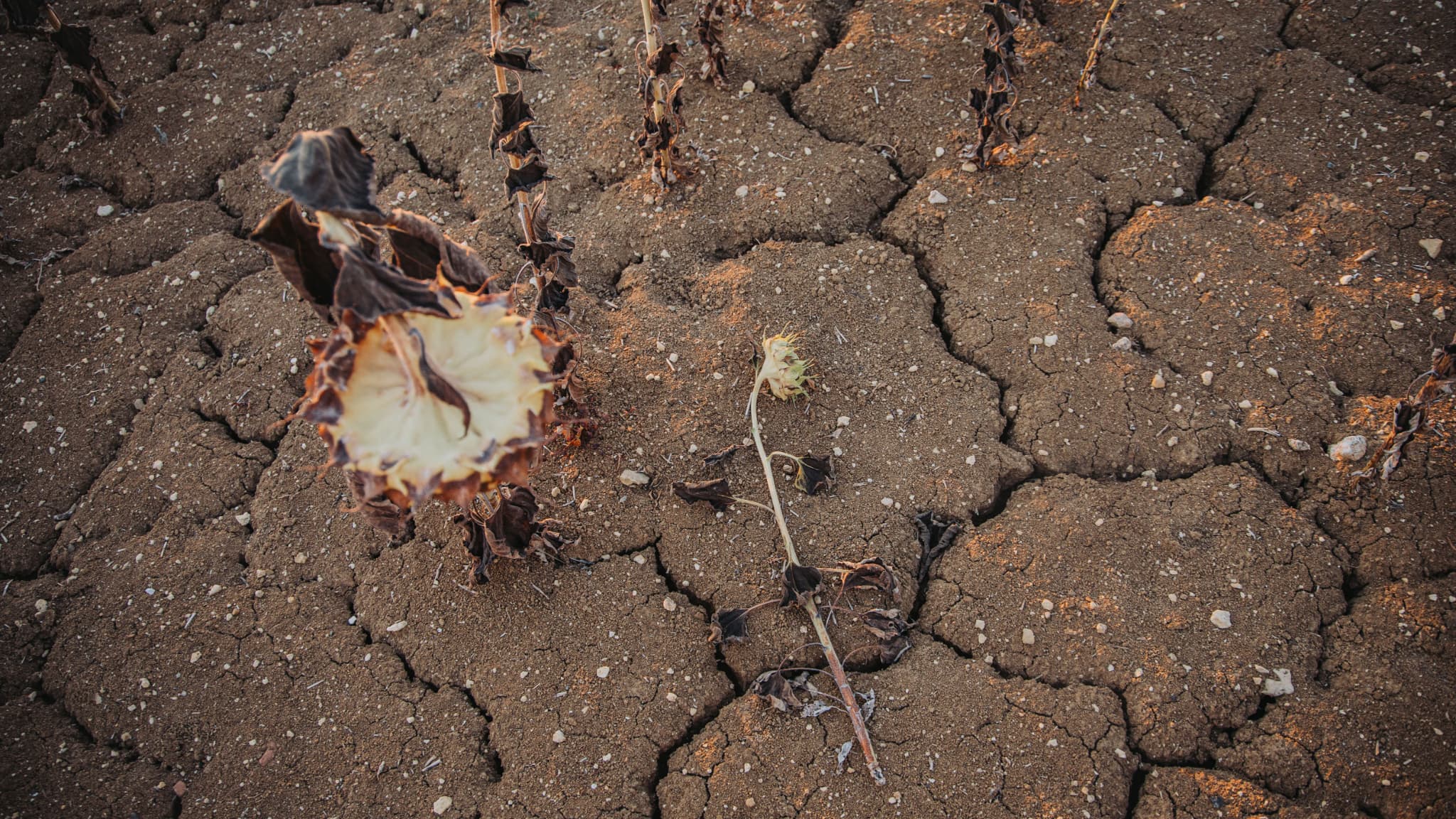
French agriculture faces a test as severe drought and relentless heatwaves grip farms from the Loire-Atlantique to the Côte-d’Or and Isère, shrinking yields, burning crops, and forcing producers to make drastic cuts to their seasonal operations. Across the country, cultivators report that months of virtually uninterrupted dry weather and extreme temperatures have devastated harvests, depleted irrigation reserves, and pushed farm budgets into deep uncertainty as the summer draws to a close.
In Saint-Philbert-de-Grand-Lieu in the Loire-Atlantique department, organic market gardener Arnaud Pirault has watched his harvest shrivel under relentless temperatures reaching 40 to 45 degrees Celsius near Nantes, with virtually no precipitation since late May. The 42-year-old producer, who has farmed the land since 2018, saw his celery-rave bulbs grow to only 300 grams instead of the expected 600 grams, alongside severely stunted spinach and salads and heavily burned eggplants. Facing empty ponds and exhausted water reserves by late June, Pirault made the difficult decision to halt planting and sowing across the vast majority of his 30 hectares, narrowing his focus exclusively to three hectares of zucchinis and eggplants.
The economic fallout has rippled quickly through his local operations. Pirault was forced to cut his seasonal workforce in half, retaining just eight fixed-term contracts rather than the 20 initially planned for the summer. With his annual turnover projected to drop by a factor of three, he is preparing for upcoming banking discussions in October to restructure his debt over 15 years instead of 10 to offset expected financial losses. Despite the challenges, he remains focused on adapting his business model for future seasons, noting that water conservation will necessitate scaling back spring planting to preserve vital moisture for peak summer heat.
Hundreds of kilometers to the east in Merseuil, Côte-d’Or, cereal and wine producer Cédric Dury describes a grim landscape. Cultivating colza, wheat, barley, soybeans, corn, and vineyards, Dury notes that local corn crops usually maintain a vibrant green color at this time of year but are now completely dried out. According to Dury, vineyards are yielding only half-harvests while grain production has suffered severe damage, with soybean and corn yields expected to drop to between 10 and 15 percent of normal levels.
The compounding pressures of climate stress and rising overhead costs have deepened the crisis for French growers. Dury points out that soaring expenses for fuel, fertilizers, and phytosanitary products continue to climb while crop volumes plunge. Furthermore, an exceptionally early heat-accelerated maturation prompted record-early grape harvests across Champagne and other wine regions, following dry conditions the previous year.
Irrigation Quotas, Pests, and Rising Energy Costs in Isère
Further south in Isère, cereal farmer Thierry Boiron has confronted severe logistical and financial hurdles managing crop irrigation near Ornacieux-Balbins. The 61-year-old producer began pumping water from his well in early June rather than the usual early July, consuming volumes of water not seen in his 30 years of farming. Consequently, Boiron exceeded irrigation quotas established by the prefecture and the collective water management organization, known as the Organisme Unique de Gestion Collective (OUGC).
Escalating electricity bills for his electric irrigation pumps compounded the financial strain, driving energy costs to 18,000 euros for the month of July alone. Faced with soaring power tariffs and strict administrative limits, Boiron ultimately chose to shut off irrigation on select parcels to curb expenses, accepting partial crop loss rather than accumulating unmanageable debt. In addition to water scarcity, extreme daytime temperatures exceeding 35 degrees Celsius disrupted corn pollination, while unaccustomed pests such as field bugs attacked crop ears alongside the presence of western corn rootworms.
Wheat and colza harvests in the Isère region proved disappointing, leaving little room for profit even as wheat market prices experienced a slight recovery. Boiron delayed autumn rapeseed planting because the soil remained insufficiently moist, and he has postponed orders for wheat seeds and fertilizers while monitoring weather patterns. With operational investments on his 140-hectare farm running costs of approximately 1,000 euros per hectare in borrowed capital, he notes that proper autumn groundwater replenishment is essential to avoid soils that cannot be sown in autumn cereals.
Retailer Adjustments and Next Steps for the Agricultural Sector
In response to the mounting crisis, the Fédération du Commerce et de la Distribution (FCD)—which represents major French supermarket groups including E.Leclerc, Coopérative U, Carrefour, Auchan, Groupement Les Mousquetaires, Intermarché, and Casino—announced policy shifts on Tuesday, August 18. Retail leadership confirmed plans to exercise greater flexibility regarding the visual appearance and sizing standards of fresh fruits and vegetables while prioritizing the sourcing of domestic French produce to support domestic growers facing exceptional weather extremes.

As agricultural producers across France look toward incoming autumn weather forecasts, their immediate operational focus remains tied to upcoming precipitation levels that will dictate autumn sowing schedules and groundwater recovery.
Related reading