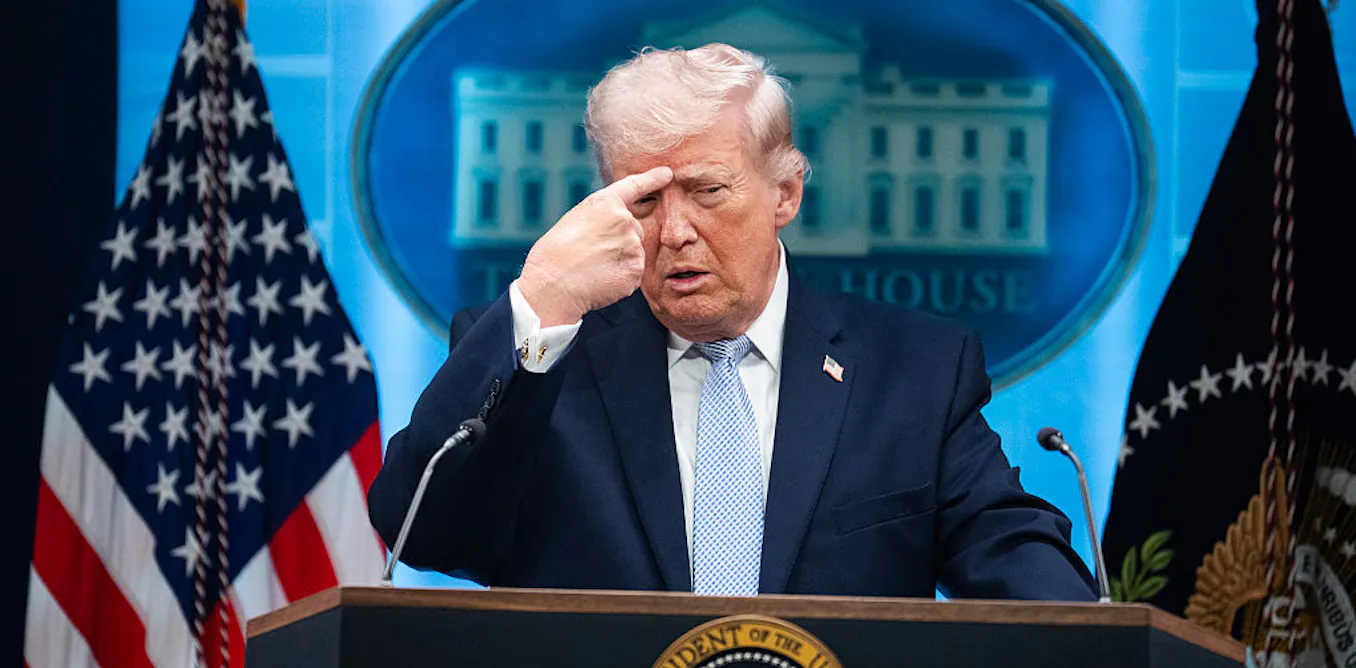
The volatility of global markets often mirrors the stability of the world’s most powerful executive offices. As a financial journalist and economist, I have long observed how political uncertainty translates into economic shock. Nowhere was this more evident than this week, as the world held its breath over a potential escalation in the Middle East that threatened the very arteries of global energy transit.
The crisis centered on the Strait of Hormuz, a narrow waterway that carries roughly 20 million barrels of oil a day and approximately one-fifth of the world’s liquefied natural gas according to Fox News. When President Donald Trump issued a belligerent ultimatum demanding that Iran “Open the Fuckin’ Strait,” the rhetoric shifted from standard diplomatic pressure to something far more alarming. The President warned that “a whole civilization will die tonight, never to be brought back again” if a deal was not reached by an 8 p.m. ET deadline via CNBC.
While a two-week ceasefire was eventually reached on April 7, 2026—following diplomatic intervention by Pakistan’s Prime Minister Shehbaz Sharif and Field Marshal Asim Munir—the fallout was immediate. The sheer scale of the threats sparked an unprecedented wave of bipartisan alarm within the United States. From Democratic Representative Alexandria Ocasio-Cortez to former Representative Marjorie Taylor Greene and right-wing commentator Alex Jones, voices across the political spectrum began questioning the President’s mental fitness and calling for his removal.
For those outside the U.S. Political bubble, the question often arises: what actually happens when a president is deemed unfit for office? The U.S. Constitution provides two primary, yet vastly different, mechanisms for removing a US president from office: the 25th Amendment and the process of impeachment.
The 25th Amendment: Addressing Presidential Disability
The 25th Amendment was ratified in 1967 to fill critical gaps in the Constitution regarding presidential succession and disability via Cornell Law School. It was created in the wake of the 1963 assassination of John F. Kennedy and concerns over the undisclosed health struggles of previous presidents, such as Dwight Eisenhower.
While the amendment is most commonly known for filling a vice-presidential vacancy, Section 4 is the most controversial and potent tool for addressing a president who is “unable to discharge the powers and duties of his office.” Unlike impeachment, which is a punitive process for misconduct, Section 4 is designed to handle incapacity—whether physical or mental.
The process for an involuntary removal under the 25th Amendment is as follows:
- The Declaration: The Vice President and a majority of the Cabinet (or another body designated by Congress) must send a written declaration to the Speaker of the House and the President pro tempore of the Senate stating that the President is unfit.
- Immediate Transfer: Upon the delivery of this notice, the Vice President immediately assumes the role of Acting President.
- The Presidential Challenge: The President can fight back by submitting a written declaration to Congress stating that no disability exists.
- The Final Decision: If the Vice President and the Cabinet still disagree, they have four days to notify Congress. Congress must then convene within 48 hours and has 21 days to debate and vote.
- The Threshold: A two-thirds majority vote in both the House and the Senate is required to permanently maintain the Vice President in power. If the vote fails or the 21-day window closes, the President resumes their duties.
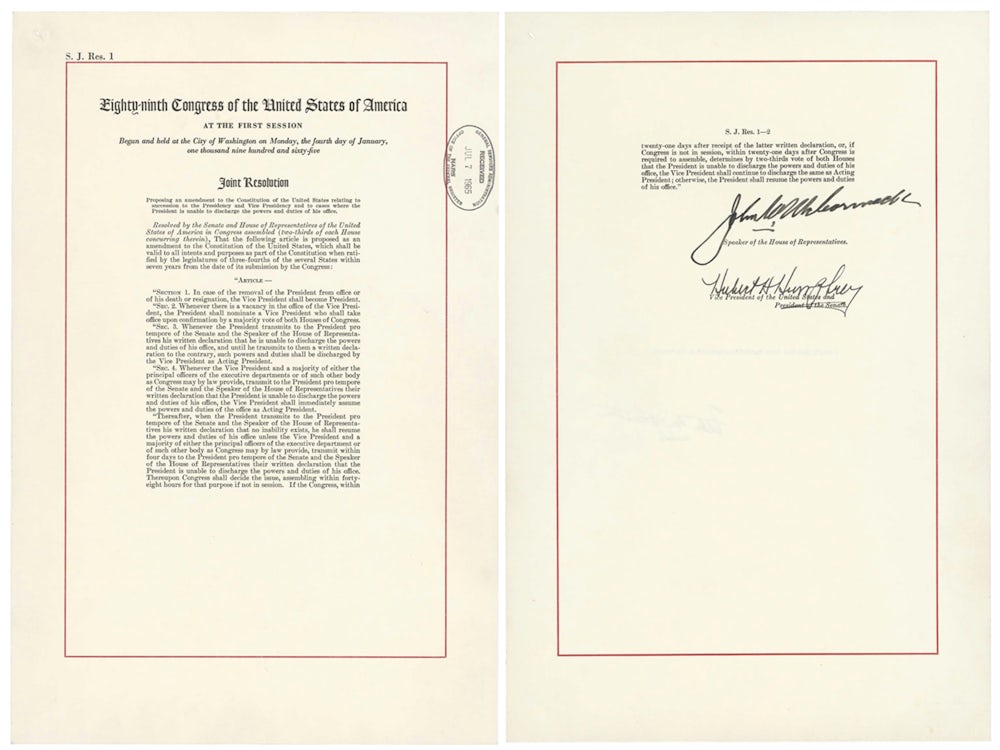
Historically, the 25th Amendment has never been invoked against a president’s will. It has been used primarily for temporary transfers of power, such as when a president is under general anesthesia for a medical procedure.
Impeachment: Removal for ‘High Crimes and Misdemeanors’
While the 25th Amendment deals with fitness and disability, impeachment is a legal and political process designed to punish misconduct. Under Article II of the Constitution, Congress has the authority to remove a president for “Treason, Bribery, or other high Crimes and Misdemeanors” via the National Archives.
The impeachment process is divided between the two chambers of Congress, acting as a prosecutor and a judge, respectively.
The Role of the House of Representatives
The House of Representatives holds the “sole Power of Impeachment.” The process typically begins with a resolution filed by a member of the House, which is then referred to the House Judiciary Committee. After hearings and evaluations, the committee may draft articles of impeachment. If a simple majority of the full House votes in favor of any of these articles, the president is officially “impeached”—which is essentially a formal charge, not a removal from office.
The Role of the US Senate
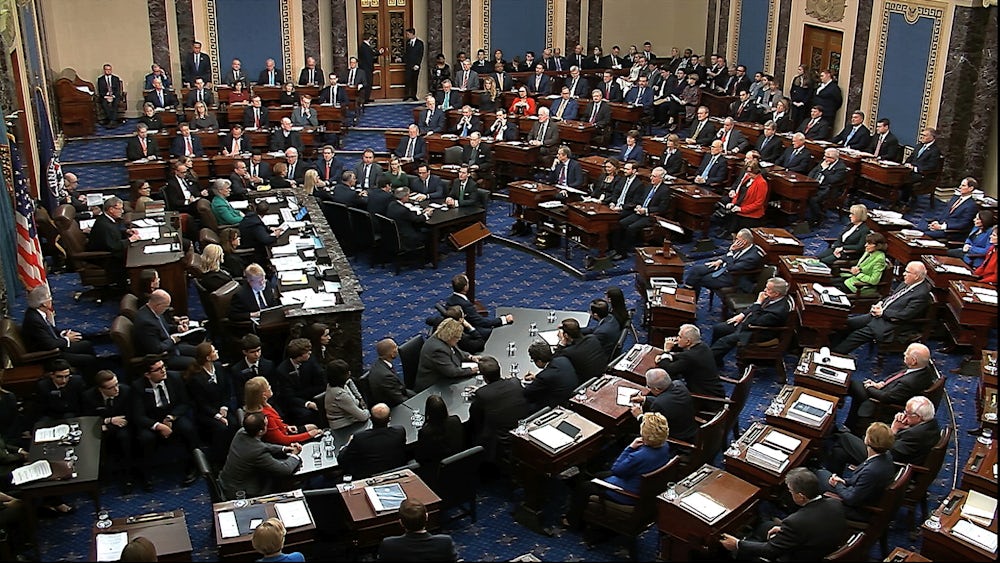
Once impeached by the House, the matter moves to the Senate for a trial. The Senate determines whether the president should be convicted and removed from office. This requires a high bar: a two-thirds majority (67 senators) must vote for conviction via the US Senate.
To date, no U.S. President has ever been convicted and removed from office by the Senate, though President Andrew Johnson came within one vote of removal in 1868.
Beyond removal, the Senate holds a second, separate power. If a president is convicted, the Senate can vote to permanently disqualify that person from holding any future federal office. This second vote requires only a simple majority.
Market Implications and the ‘Stability Premium’
From a business perspective, the debate over removing a US president from office is not merely a legal curiosity; it is a matter of systemic risk. The markets crave predictability. When the leadership of the world’s largest economy is questioned, the “stability premium” vanishes, leading to extreme volatility.
We saw this play out in real-time during the Strait of Hormuz crisis. As the threat of destroying “a whole civilization” loomed, oil and gas prices surged worldwide. Although, the moment the ceasefire was announced on April 7, oil prices plunged as much as 16%, and U.S. Stock futures shot upward via CNBC. This rapid swing highlights how sensitive global trade is to the perceived stability and predictability of the U.S. Executive.
The calls for removal—regardless of their political origin—signal a breakdown in the perceived reliability of the presidency. When bipartisan figures like Rep. Melanie Stansbury and former Rep. Marjorie Taylor Greene align in their concern, it suggests that the volatility is no longer seen as a political strategy, but as a liability to national and global security.
Summary of Constitutional Removal Mechanisms
| Feature | 25th Amendment (Section 4) | Impeachment |
|---|---|---|
| Primary Cause | Incapacity/Unable to discharge duties | Treason, Bribery, High Crimes/Misdemeanors |
| Initiators | Vice President + Majority of Cabinet | House of Representatives |
| Immediate Effect | VP becomes Acting President | President remains in office during trial |
| Final Decision | 2/3 Vote in both House and Senate | 2/3 Vote in the Senate |
| Potential Outcome | Permanent transfer of power | Removal and/or future disqualification |
As we move forward, the world will be watching the two-week window of the ceasefire closely. The primary checkpoint will be the expiration of this interval, during which the “complete, immediate, and safe opening” of the Strait of Hormuz must be maintained to avoid a return to the brink of conflict.
Do you believe the current constitutional checks and balances are sufficient for the complexities of modern geopolitical crises? Share your thoughts in the comments below or share this analysis with your network.
Related reading