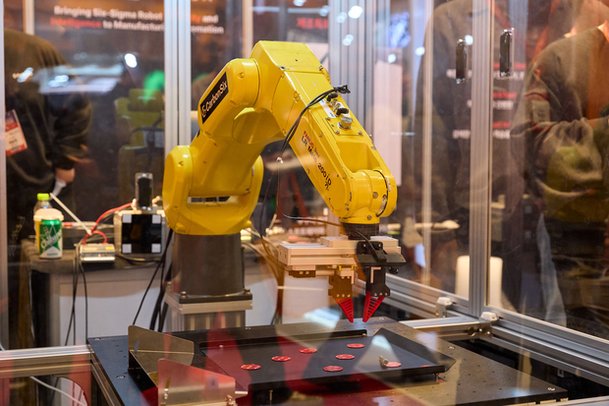
Seoul, South Korea – The future of manufacturing was on display this week at the AutomationWorld (AW) 2026 exhibition held at Coex in Seoul, with a significant focus on the advancements in physical AI and robotics. Among the companies showcasing cutting-edge technology was CarbonSIX, a physical AI firm that demonstrated robotic intelligence capable of being implemented directly into existing manufacturing processes. This demonstration signals a potential shift towards more adaptable and efficient production lines, addressing challenges previously insurmountable with traditional automation solutions.
CarbonSIX’s presentation centered around solving complex, non-standardized assembly tasks – a persistent hurdle for manufacturers. The company showcased its AI-powered robots successfully performing “cable connector attachment” and “component loop hanging,” tasks often requiring the dexterity and adaptability of a human worker. What sets CarbonSIX apart, according to attendees, is the robots’ ability to operate at production speeds that meet current manufacturing demands, representing a leap beyond research and development into practical, large-scale application. DataNet Korea reports that the company is aiming to provide industrial physical AI solutions that are immediately deployable and scalable.
The Challenge of Non-Standardized Assembly
Traditional automation excels at repetitive, highly structured tasks. Although, many manufacturing processes involve variations in part placement, orientation, and even the parts themselves. These “non-standardized” assembly tasks have historically been challenging to automate, requiring significant programming and recalibration for even minor changes. This is particularly true in industries like automotive, where components are often subject to slight variations during production. CarbonSIX’s technology aims to overcome these limitations by leveraging physical AI, allowing robots to adapt to these variations in real-time.
The demonstration highlighted the automation of cable connector attachment within an automotive assembly line. The robots were able to reliably grasp and connect connectors, even when subjected to the unpredictable movements common in a prompt-paced production environment. This capability addresses a key pain point for automotive manufacturers, who often rely on manual labor for these delicate and precise tasks. Similarly, the “component loop hanging” demonstration showcased the robot’s ability to handle diverse shapes and varying positions, a challenge in processes like painting and post-processing. The company’s approach maintains both speed and accuracy, crucial factors for industrial applications.
Physical AI: Bridging the Gap Between Virtual and Real-World Robotics
Physical AI represents a significant evolution in robotics, moving beyond pre-programmed instructions to systems that can learn and adapt through interaction with the physical world. Unlike traditional robots that rely on precise models of their environment, physical AI robots use sensors and machine learning algorithms to perceive and respond to real-time changes. This allows them to handle uncertainty and variability, making them suitable for a wider range of tasks. AutomationWorld 2026 featured Physical AI as a central theme, alongside robotics, AI factories, autonomous manufacturing, and humanoid robots, indicating its growing importance in the industry.
According to Moon Tae-yeon, CEO of CarbonSIX, the company’s focus is on delivering industrial physical AI solutions that are not merely prototypes but are ready for mass production. “CarbonSIX has strived to demonstrate that it is a company that presents industrial physical AI solutions that can be immediately applied to the manufacturing site and are capable of mass production,” Moon stated, as reported by DataNet Korea. This emphasis on practical application resonated with attendees, with many reportedly inquiring about implementation timelines, integration strategies, and return on investment.
AutomationWorld 2026: A Hub for Manufacturing Innovation
AutomationWorld 2026, held from March 4th to 6th at Coex, Seoul, served as a comprehensive showcase of manufacturing AI innovation. The event featured exhibitors and visitors from across the globe, focusing on areas such as physical AI, robotics, AI factories, and autonomous manufacturing. The exhibition included the newly opened ‘AI Factory Special Pavilion,’ dedicated to showcasing the latest advancements in AI-driven manufacturing technologies. The event’s scale included exhibitors and visitors, though specific numbers were not immediately available. The AutomationWorld website provides detailed information about the event, including floor plans, exhibitor directories, and visitor guidelines.
The exhibition highlighted the growing trend towards smart factories and the increasing adoption of automation technologies. Beyond CarbonSIX, numerous companies presented solutions aimed at improving efficiency, reducing costs, and enhancing product quality. The focus on humanoid robots and autonomous manufacturing suggests a future where robots play an even more prominent role in the manufacturing process, working alongside humans to create more flexible and resilient production systems.
Impact and Future Outlook
The advancements showcased by CarbonSIX and other exhibitors at AutomationWorld 2026 have the potential to significantly impact the manufacturing industry. By automating complex assembly tasks, companies can reduce labor costs, improve product quality, and increase production capacity. The ability to adapt to variations in parts and processes likewise allows for greater flexibility and responsiveness to changing market demands.
The increasing adoption of physical AI and robotics is also likely to create new job opportunities in areas such as robot programming, maintenance, and data analysis. However, it is also crucial to address the potential displacement of workers in traditional manufacturing roles through retraining and upskilling programs. The successful integration of these technologies will require collaboration between industry, government, and educational institutions.
Looking ahead, the trend towards more intelligent and adaptable manufacturing systems is expected to continue. As AI algorithms become more sophisticated and sensors become more affordable, we can expect to see even more innovative applications of physical AI and robotics in the manufacturing sector. The developments showcased at AutomationWorld 2026 provide a glimpse into this future, where robots and humans work together to create a more efficient, sustainable, and resilient manufacturing ecosystem.
The next step for CarbonSIX will be to expand the deployment of its technology to a wider range of manufacturing applications and to continue refining its AI algorithms to improve performance and reliability. The company’s success will depend on its ability to demonstrate the value of its solutions to potential customers and to build strong partnerships with leading manufacturers. Further updates on CarbonSIX’s progress and the broader trends in manufacturing automation can be found on the AutomationWorld website and through industry publications like DataNet Korea.
What are your thoughts on the future of AI in manufacturing? Share your comments below and let us grasp how you see these technologies impacting your industry.
Worth a look