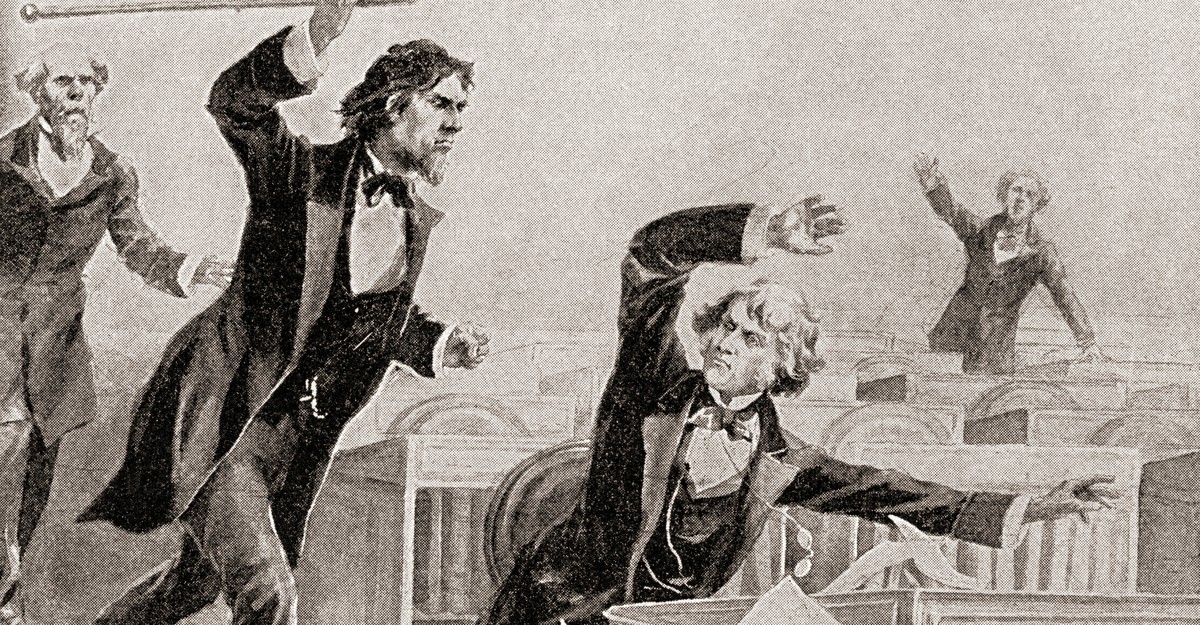
The history of American political discourse is often traced back to moments of profound rupture, yet few events have left a more indelible mark on the nation’s conscience than the violent beating that reshaped America. On May 22, 1856, the U.S. Senate chamber—a place intended for deliberation and debate—became the site of a brutal confrontation that underscored the fragility of civil order when faced with the volatile issue of slavery. Representative Preston Brooks of South Carolina assaulted Senator Charles Sumner of Massachusetts, an act that reverberated across a country already fractured by ideological divisions.
The incident remains a pivotal case study for historians and political analysts, serving as a grim reminder of how rhetoric and physical violence can become inextricably linked in the public imagination. As we reflect on the evolution of American democracy, the caning of Charles Sumner stands as a harrowing testament to the breakdown of civil discourse and the long-term consequences of political polarization.
A Clash of Ideologies in the Senate
The origins of the attack were rooted in the intense debates surrounding the status of slavery in the Kansas Territory. Senator Charles Sumner, a staunch abolitionist, had delivered a multi-day address titled “The Crime Against Kansas” in May 1856. In his speech, Sumner directed scathing criticism toward the institution of slavery and specifically targeted Senator Andrew P. Butler of South Carolina, a relative of Preston Brooks. Sumner’s rhetoric, which included sharp personal barbs, was viewed by his Southern colleagues as a direct affront to their honor and the reputation of the South.
According to historical records maintained by the United States Senate, the assault occurred just days after the conclusion of Sumner’s speech. Preston Brooks entered the Senate chamber armed with a gutta-percha cane, approaching Sumner while he was seated at his desk. The physical nature of the attack, which left Sumner severely injured and unable to return to his duties for several years, signaled to the nation that the era of compromise had effectively ended. The violence served as a catalyst for increased sectional tensions, further alienating the North and South as the country moved toward the Civil War.
The Legacy of “Bleeding Sumner”
The immediate aftermath of the caning transformed both men into potent symbols. For the burgeoning Republican Party, the incident provided a rallying cry, with the phrases “Bleeding Kansas” and “Bleeding Sumner” becoming central to their political campaigns. The assault was widely reported in the press and the circulation of Sumner’s speech, which reached hundreds of thousands of copies, solidified his status as a martyr for the abolitionist cause. The Library of Congress archives document how the event galvanized Northern public opinion, framing the struggle against slavery as a moral imperative that transcended mere political disagreement.
Conversely, in the South, Brooks was celebrated by many as a defender of regional honor. Despite being censured by the House of Representatives and facing a criminal fine of $300, he resigned his seat only to be re-elected by his constituents, demonstrating the deep partisan divide that defined the mid-19th century. This dichotomy—where one side saw a victim of tyranny and the other a defender of tradition—illustrates the difficulty of maintaining a unified national identity during periods of extreme ideological conflict.
Modern Parallels and the Nature of Political Rhetoric
In the contemporary era, the specter of political violence continues to haunt the American landscape. Modern commentators and historians frequently invoke the Sumner-Brooks incident when discussing the consequences of “poisonous words” in political discourse. However, the comparison is often nuanced. While some argue that inflammatory rhetoric inevitably leads to physical confrontation, others maintain that challenging an oppressive status quo necessitates strong, confrontational language, and that the resulting violence is a reflection of the existing power structure rather than the speech itself.
The distinction between aggressive rhetoric and actual violence remains a subject of intense debate. As noted in analyses by the Brennan Center for Justice, the health of a democracy depends on the ability of its citizens and representatives to engage in robust debate without resorting to intimidation or force. The lesson of 1856 is not merely that words can have consequences, but that the structures of governance are only as strong as the commitment of those in power to uphold the rule of law over personal or partisan vengeance.
Historical Reflection and Institutional Memory
The long-term impact of Sumner’s political career extends far beyond the incident in the Senate chamber. Following the Civil War, Sumner became a key architect of civil rights legislation, advocating for the rights of formerly enslaved people and pushing for the legal framework that would eventually underpin the 14th and 15th Amendments. His efforts to ensure “equality before the law” established a precedent for future civil rights movements, including the landmark 1954 ruling in Brown v. Board of Education, which ended legal segregation in public schools.

Today, the empty chair of Charles Sumner and the historical accounts of the caning serve as educational tools for understanding the risks of unchecked polarization. Museums and historical societies, such as the National Park Service, continue to preserve the memory of these events to ensure that the lessons of the past are not forgotten. By examining the lives of those caught in the maelstrom of the 1850s, we gain a clearer understanding of the challenges facing our own institutions.
As we navigate an increasingly complex political environment, the story of the caning of Charles Sumner remains a cautionary tale. It invites us to consider the role of empathy, the importance of civil discourse, and the enduring necessity of protecting the democratic process from the encroachment of violence. We encourage our readers to engage in the ongoing conversation about how to best preserve the integrity of our political institutions. Share your thoughts on how historical lessons might inform our current challenges in the comments section below.