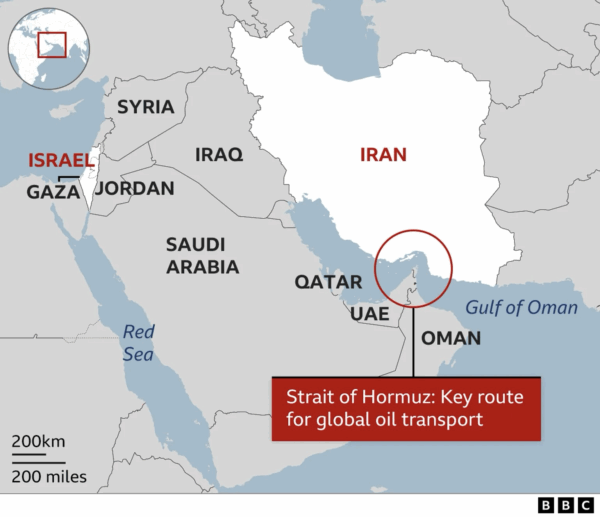
President Donald Trump has ordered the U.S. Navy to initiate a blockade of the Strait of Hormuz, a critical maritime chokepoint connecting the Persian Gulf to the Gulf of Oman. The decision follows the collapse of peace talks with Tehran, which ended in a stalemate. The administration is now moving to interdict vessels that have paid tolls to Iran to pass through the waterway, characterizing the Iranian regime’s actions as “world extortion.”
The move comes as the U.S. Seeks to force the unconditional reopening of the strait, which has seen Iranian forces restrict oil tanker traffic. While the strait is not entirely closed, Iran has been allowing some vessels to pass in exchange for tolls reaching up to $2 million per ship according to CNN. This restriction has triggered global economic turmoil and caused oil prices to surge worldwide, including within the United States.
The U.S. Navy’s mission involves not only the blockade of ships entering or leaving the strait but also the active destruction of sea mines. U.S. Intelligence assessments have previously indicated the presence of at least a dozen Iranian mines in the area via CBS News. The administration’s strategy aims to cut off a primary source of financing for Iran’s government and military operations by denying safe passage to any vessel that complies with the illegal toll system.
The Strategy Behind the U.S. Navy Blockade
President Trump announced the operation via Truth Social, stating that the U.S. Navy would “begin the process of BLOCKADING any and all ships trying to enter or depart the Strait of Hormuz.” He emphasized that the ultimate goal is a state where “ALL BEING ALLOWED TO Travel IN, ALL BEING ALLOWED TO GO OUT,” but asserted that Iran has actively prevented this outcome.
The blockade serves as a high-stakes lever in a broader conflict. By blocking the strait—including the passage of Iranian oil—the U.S. Intends to cripple the financial capabilities of the Iranian regime. Data from Kpler shows that Iran managed to export an average of 1.85 million barrels of crude a day through March 2026, an increase of about 100,000 barrels per day over the preceding three months per CNN reporting. Cutting off this flow represents a significant economic blow to Tehran.
The “doctrine of preemption,” as described by Shervin Pishevar, an advisor to HRH Reza Pahlavi, argues that these decisive actions are necessary to prevent future threats from Iran’s evolving drone, ICBM and nuclear programs via Fox News. The administration has signaled that any Iranian forces that fire upon U.S. Personnel will be “BLOWN TO HELL!”
Escalation and Previous Ultimatums
This current blockade follows a period of intense volatility in March 2026. On Monday, March 24, President Trump had initially issued an ultimatum for Iran to reopen the Strait of Hormuz or face strikes on its power plants according to CBS News. That deadline was briefly postponed amid “good and productive” peace talks, though Iranian state media denied such talks were occurring, claiming the U.S. Had retreated out of fear.
During that window of escalation, Iran responded to U.S. Threats with attacks on Israel and various Gulf states. Tehran also threatened to respond to any strikes on its energy infrastructure by laying sea mines across the “entire Persian Gulf” per CBS News. The U.S. Central Command has already reported hitting more than 9,000 Iranian targets, including over 140 naval vessels, and conducting upwards of 9,000 combat flights since the start of the war.
Global Economic Impact and Energy Security
The Strait of Hormuz is one of the world’s most vital maritime passages, serving as the primary artery for global energy supplies. The Iranian decision to restrict traffic and implement a toll system has created severe economic damage for countries dependent on Middle Eastern crude. This has led to price spikes that have forced some Asian nations to increase their reliance on polluting coal to address energy shortages via CBS News.
The U.S. Blockade introduces a paradoxical risk: while it aims to force the strait open for the global community, the act of blockading the waterway—even to Iranian oil—could further drive up global oil prices in the short term. Still, the administration views this as a necessary cost to stop “world extortion” and dismantle the financial infrastructure supporting the Iranian military.
Human and Military Costs
The conflict has exacted a heavy toll. A rights group reports that U.S.-Israeli strikes have killed more than 3,200 people in Iran, including at least 214 children according to CBS News. Despite these strikes, Iran has demonstrated a continued ability to retaliate, albeit at a slower pace than the initial U.S. Offensive.
| Date | Event | Outcome/Detail |
|---|---|---|
| March 24, 2026 | Trump issues ultimatum to reopen strait | Threatened strikes on power plants; later postponed for talks CBS News |
| March 2026 (Avg) | Iranian oil exports | Averaged 1.85 million barrels of crude per day CNN |
| April 12, 2026 | Blockade announced | Trump orders Navy to block all ships and interdict toll-payers Fox News |
As the U.S. Navy begins the process of clearing mines and interdicting vessels, the international community remains watchful for any further escalation. The administration continues to demand that Iran receive the international waterway open “FAST!”
The next critical checkpoint will be the U.S. Navy’s progress in clearing the reported sea mines and the subsequent impact on oil transit volumes through the strait. We will provide updates as official reports from the U.S. Central Command become available.
Do you believe a naval blockade is the most effective way to ensure energy security in the Middle East? Share your thoughts in the comments below and share this report with your network.
Keep reading