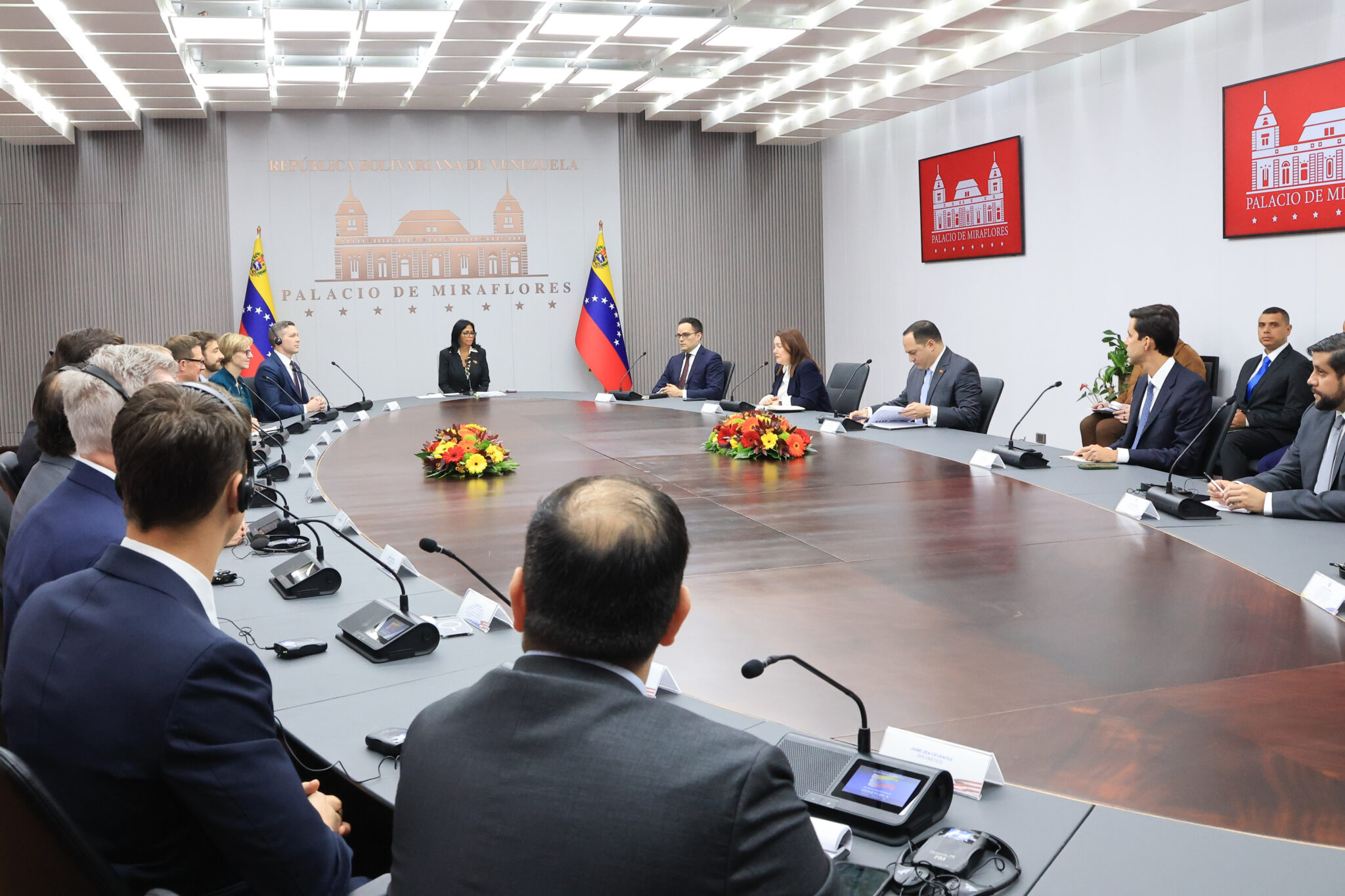
Presidenta (E) Delcy Rodríguez received U.S. Deputy Secretary of the Office of Fossil Energy and Carbon Management, Kyle Haustveit, and a delegation from the U.S. Department of Energy at the Miraflores Palace in Caracas on Tuesday, April 14, 2026. The meeting focused on strengthening bilateral diplomatic and commercial ties, with particular emphasis on evaluating fresh investment opportunities and technical cooperation in the hydrocarbons sector. According to official Venezuelan presidential press releases, the dialogue aimed to mutualize interests in ensuring regional energy stability and fostering a business architecture grounded in respect and shared benefit.
The encounter marked the third high-level engagement between Caracas and Washington in under three months, reflecting the deepening of bilateral rapprochement following the January 3, 2026 detention of former Venezuelan president Nicolás Maduro. During the meeting, Rodríguez directly appealed to U.S. President Donald Trump for the removal of sanctions imposed on Venezuela, arguing that legal certainty is essential for long-term investment. “An investor requires greater legal security. A license does not provide legal security in long-term projection, because This proves subject to temporality,” she stated, as broadcast by state television VTV.
Rodríguez was joined by several senior officials, including U.S. Chargé d’Affaires Laura Dogu, Minister of People’s Power for Hydrocarbons Paula Henao, PDVSA President Héctor Obregón, and Vice Minister for Europe and North America Oliver Blanco. The meeting occurred on the same day that the U.S. Treasury’s Office of Foreign Assets Control (OFAC) issued General Licenses 56 and 57, which expand the scope of permissible economic transactions with Venezuela. General License 56 authorizes negotiating commercial contracts with the Venezuelan government, while General License 57 permits financial transactions with four state-owned banks: the Central Bank of Venezuela, Banco de Venezuela, Banco Digital de los Trabajadores, and Banco del Tesoro.
The April 14 meeting followed a significant agreement signed the previous day, April 13, between Venezuela’s state oil company PDVSA and the U.S. Energy corporation Chevron. Under the asset swap deal, PDVSA transferred a natural gas field license to Chevron in exchange for incorporating the Ayacucho 8 oil field into the operations of the mixed enterprise PetroPiar. This arrangement was framed by Venezuelan authorities as a step toward sustainable economic recovery and maximizing the use of national natural resources for public welfare.
Both nations emphasized their shared interest in positioning Venezuela as a reliable and secure energy partner. Officials highlighted that the talks reinforce commitments to transparent, mutually beneficial cooperation in energy development. The Venezuelan government reiterated its goal of attracting responsible foreign investment while maintaining sovereignty over its hydrocarbon wealth.
The discussions reach amid broader efforts to normalize U.S.-Venezuela relations after years of diplomatic strain. Analysts note that energy cooperation has emerged as a potential bridge for dialogue, particularly given Venezuela’s vast oil reserves and the United States’ ongoing demand for stable energy supplies. However, progress remains contingent on resolving outstanding political differences, including concerns over democratic governance and human rights.
As of now, no further meetings between Rodríguez and U.S. Energy officials have been publicly scheduled. Observers suggest that future engagement may depend on the implementation of existing agreements and the evolution of sanctions policy. The next formal update on bilateral energy talks is expected through official channels from either the Venezuelan Ministry of People’s Power for Hydrocarbons or the U.S. Department of Energy.
For continued coverage of international diplomacy, energy policy, and Latin American affairs, readers are encouraged to follow updates from trusted global news sources. Share your thoughts on how energy diplomacy shapes global relations in the comments below.
Worth a look